Caption: All pictures used in this article are from Wikipedia Creative Commons.
The light we hide is often the very light someone else needs to find their way.
Susana G Baumann
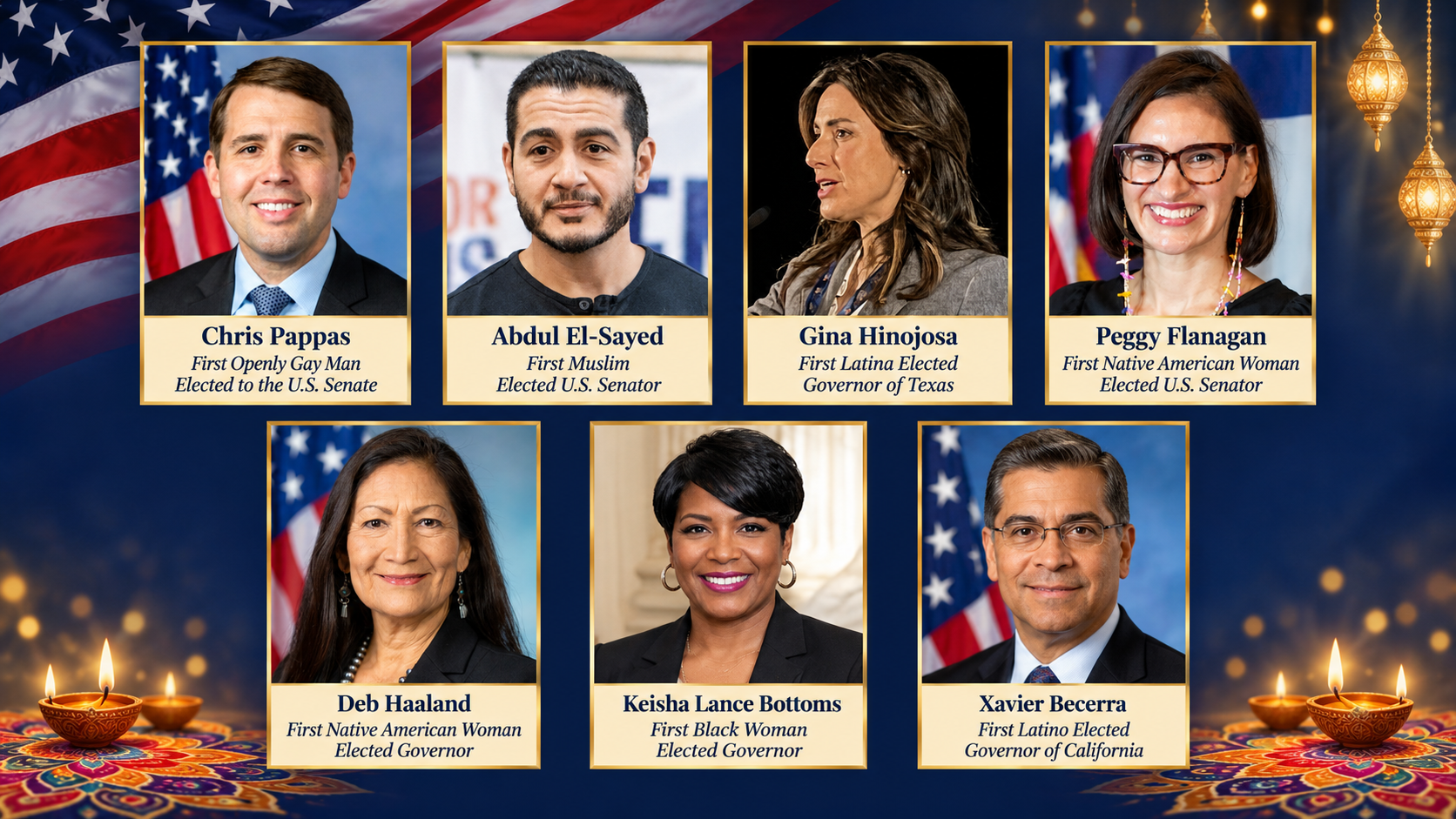
This year, Diwali arrived five days after Election Day. Seven historic firsts made the festival of lights feel especially bright.
On Sunday, November 8, millions of families around the world lit their diyas for Diwali, the festival of lights celebrated by Hindus, Jains and Sikhs. Small clay lamps lined doorways and windowsills. Rangoli patterns bloomed on floors in bright powders. Sweets were shared with neighbors, and homes were cleaned and opened to welcome Lakshmi, the goddess of prosperity.
At the heart of Diwali is one of the oldest stories humanity tells: the victory of light over darkness, of knowledge over ignorance, of good over evil. In one of its best-known traditions, the people of Ayodhya lit rows of lamps to guide Lord Rama home after years of exile. No single lamp could light the way alone. Together, they turned the night into day.
I have been thinking about that image all week, because Diwali arrived just five days after an election that lit some very old corners of American public life.
The darkness these leaders pushed back
If you have been following me on social media, you probably know I lean Democrat. In a democracy, losing an election is part of the system working, and many of those who lost might have served their states honorably. Others didn’t. That is part of the darkness.
The other part in the darkness I mean is quieter. It is the long stretch of history in which certain people were told, in a thousand small ways, that leadership was not for them. It is the empty space in the portrait galleries of state capitols. It is the little girl who never saw a governor who looked like her, and the immigrant’s son who learned to keep his family’s story to himself.
On November 3, 2026, voters in seven states lit seven new lamps in that darkness.
Seven lamps, seven stories
Keisha Lance Bottoms, Georgia
The daughter of soul singer Major Lance, Keisha Lance Bottoms built her career as an attorney, a magistrate judge, a member of the Atlanta City Council and, eventually, the city’s mayor. On election night, she won Georgia’s governorship, becoming the state’s first woman governor, its first Black governor, and the first Black woman to serve as governor anywhere in the United States. Two hundred and fifty years into the nation’s history, that lamp had never been lit.
Deb Haaland, New Mexico
A citizen of the Pueblo of Laguna, Deb Haaland has spent her career opening doors. In 2018, she was one of the first two Native American women elected to Congress, and she later became the first Native American Cabinet secretary, leading the Department of the Interior. Now she is the first Native American woman elected governor in U.S. history. In her victory speech, she spoke directly to young people, telling every child watching that their dreams matter.
Peggy Flanagan, Minnesota
Peggy Flanagan, a member of the Ojibwe nation and Minnesota’s lieutenant governor, made history as the first Native American woman elected to the U.S. Senate. As lieutenant governor, she worked to strengthen the state’s relationship with the 11 tribal nations within Minnesota’s borders, and she brings that experience to a chamber that has waited a very long time for her voice.
Gina Hinojosa, Texas
Born in McAllen, in the Rio Grande Valley, Gina Hinojosa served Austin in the Texas House of Representatives before running for governor. On election night, she became the first Latina elected governor of Texas, in a state where Latinos have shaped the land, the language and the culture for centuries.
Xavier Becerra, California
The son of Mexican immigrants, Xavier Becerra served as California’s attorney general and as U.S. secretary of Health and Human Services. In November, he became the first Latino elected governor of California. California did have one Latino governor before him: Romualdo Pacheco, who stepped up from lieutenant governor in 1875 when the seat became vacant. Becerra is the first Latino the state’s voters have chosen for the job, in a state where roughly 40 percent of residents are Latino.
Abdul El-Sayed, Michigan
A physician and public health leader, Abdul El-Sayed once served as Detroit’s health director. This month, Michigan voters elected him to the U.S. Senate, making him the first Muslim elected to the chamber. For the many American Muslims who have heard their faith treated as a question mark on their patriotism, this lamp shines especially bright.
Chris Pappas, New Hampshire
Chris Pappas grew up working in his family’s restaurant in Manchester, a business that has served New Hampshire since 1917. After four terms in the U.S. House, he won New Hampshire’s open Senate seat and will become the first openly gay man elected to the U.S. Senate. For LGBTQ+ Americans, and for every young person still deciding whether it is safe to be fully themselves, his victory says something powerful: you can bring all of who you are and still be trusted to lead.
Why one lamp lights another
Diwali teaches that light is not diminished by sharing. One flame can light a hundred lamps and lose nothing of its own.
That is exactly how representation works. When a child sees a governor who shares her heritage, or a senator who prays the way his family prays, a door opens in her imagination. The next first becomes a little easier, and the one after that, easier still. Firsts are never the end of the story. They are the lamp at the doorway that tells everyone who follows that they, too, are welcome.
The light you carry into work
I write about multicultural professionals, and I know how many of you have spent years dimming your own light at work: shortening your name, softening your accent, keeping the stories of your family and your faith out of the conference room. This week reminded me that the light we hide is often the very light someone else needs to find their way.
Every one of these seven leaders brought their full story into public life. Their heritage, their faith and their families were not obstacles they overcame. They were part of the reason voters trusted them. That is the heart of what I teach in my book, Speak Up! Tell Your Story to Influence Others: your background is not something to hide on the way to leadership. It is the light you lead with.
This Diwali season, whatever your faith, whatever your politics and wherever your journey began, I hope you will light one lamp of your own. Tell one story you have kept in the dark. Someone may be waiting for exactly that light.
Shubh Deepavali, and Happy Diwali to everyone celebrating.
Explore more of Susana G Baumann’s work on leading from your own story.
Edited with AI.