
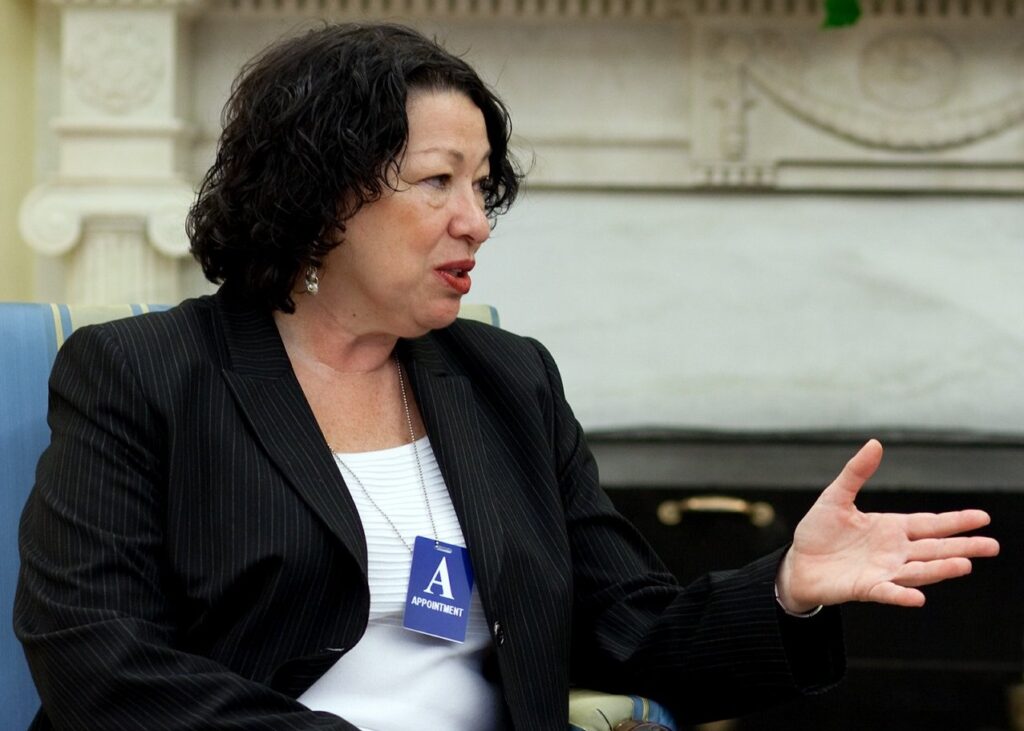
Caption: SCOTUS Sonia Sotomayor – Official White House photo by Pete Souza – Crop from File: Obama and Sotomayor.jpg, Public Domain, https://commons.wikimedia.org/w/index.php?curid=6872726
This article contains affiliate links. If you buy something through them, we may earn a small commission at no extra cost to you.
Written by the Speak Up! Team
Picture five people at the same table: Denzel Washington, Michelle Yeoh, Sonia Sotomayor, Satya Nadella and Ngozi Okonjo-Iweala. They come from five different worlds and five different starting points, and none of them sounds like the others. Yet when any of them speaks, people stop and listen.
Washington, an African American actor with two Academy Awards, holds a room with stillness and a measured pace. Yeoh, born in Malaysia, built her career across Asian and Western cinema for decades before becoming the first Asian woman to win the Oscar for Best Actress, and she carries that history with quiet authority. Sotomayor, the first Latina on the US Supreme Court, speaks openly about growing up in a Bronx housing project, and her plain-spoken candor reads as conviction rather than weakness. Nadella, born in Hyderabad, India, became CEO of Microsoft in 2014 and is widely credited with transforming the company’s culture. He speaks in a calm, measured voice with his Indian accent intact, and no one in a boardroom mistakes it for a lack of authority. Okonjo-Iweala, a Nigerian economist who became the first woman and first African to lead the World Trade Organization, is known for her blunt clarity and for wearing her Nigerian attire on the world stage.
Different accents, different temperaments, different cultures. What they share is gravitas, and none of them got it by imitating a single model of what a leader should look or sound like. That is the point of this article: gravitas is not a costume. It grows from who you are.
What is gravitas at work?
Gravitas at work is the weight your judgment carries with others, shown through composure, credibility and conviction. When you speak, people lean in, weigh what you said, and let it shape the decision. The word comes from the Latin gravis, “heavy,” and that is still the right image: what you say carries consequence.
Others perceive gravitas, but it is produced from within. Colleagues read it in how you handle a hard question, not in a trait you put on for meetings. That distinction runs through this whole article. Most advice treats gravitas as a performance that others score. I treat it as the visible result of who you are and how consistently you act on it.
It helps to name its three parts plainly:
- Composure is staying steady when the room is not. You can hear bad news, a sharp question or open disagreement without losing your footing.
- Credibility is a record other people can check. You said what would happen, and it did, or you explained honestly why it didn’t.
- Conviction is a position you can explain and are willing to hold, and willing to change when the evidence moves.
If you want the foundation for everything below, start with my explainer on what personal branding really means, which I will not repeat here.
How is gravitas different from executive presence?
Gravitas is the core of executive presence, not another word for it. The best-known model comes from economist Sylvia Ann Hewlett, whose research breaks executive presence into three pillars: gravitas (how you act), communication (how you speak) and appearance (how you look). In her work with senior leaders, gravitas is consistently the pillar that matters most.
Hewlett revisited that research a decade later for Executive Presence 2.0, published in 2023. As Chief reported in its coverage of the update, the three pillars held, but what counts as gravitas shifted. A big, charismatic personality used to mark someone as a leader. Today, leaders put more weight on staying calm under pressure, and they want confidence paired with authenticity and inclusiveness.
I admire this work as a useful map of how people judge presence. The gap is direction. The model explains how others perceive you, not where your presence comes from. Hewlett is candid about what that gap costs. She has described how women and people of color often feel pressure to “pass” as the traditional image of a leader, and how the freedom to be authentic tends to arrive later in a career, once gravitas is established.
For a rising leader, that sequence is a trap. If you have to imitate someone else’s gravitas to earn the right to show your own, you spend the most important years of your career performing. The inside-out approach starts from the other end: with what is already true about you.
Where does gravitas come from? The four inside-out pillars
Gravitas grows from the same four pillars I use to build a personal brand: values, character and personality traits, cultural attributes, and leadership interaction skills. The first three are what you bring. The fourth is how other people experience them.
Values: the source of steadiness
Values are the few non-negotiables that explain how you decide, especially when a decision costs you something. They are where composure comes from. People trust a judgment more when they have watched it hold under strain, and judgment holds when it rests on something you believe rather than on what you think the room wants to hear.
Many professionals raised in family-centered or community-centered cultures carry a strong sense of long-term responsibility into their decisions. Not everyone does, and no one should be assumed to. But if that is part of you, it belongs in how you explain your judgment, not hidden behind it. Where self-doubt erodes this steadiness, my explainer on impostor syndrome at work may help.
Character and personality traits: the source of consistency
Quiet and expressive personalities both carry gravitas. What separates them from people who lack it is consistency, not volume.
The usual advice is to command the room, which assumes gravitas needs a big presence. It doesn’t. A leader who speaks rarely but asks the same sharp questions every time, names risks plainly and follows through builds as much weight as one who fills the room. An expressive leader earns weight the same way: by being predictable in judgment, not in tone. Your temperament is material to work with, not a defect to correct.
Cultural attributes: the source of a distinct voice
Cultures differ in tendencies around directness, deference, humility and speaking order, so authority gets signaled in different ways. Gravitas keeps its meaning while the signals widen.
Within any culture, people vary, but the tendencies are real. Some leaders show conviction through warmth and a personal appeal. Others show it through precise, unsoftened critique. Others show respect for a senior voice by waiting before they speak, or by raising disagreement privately before a meeting rather than in it. A single default can misread each of them as soft, rude or passive.
Names are part of this story too. My piece on what a name carries looks at why that matters at work. I also explore how origin becomes leadership material in Tango and multicultural storytelling at work.
Leadership interaction skills: where gravitas becomes influence
Leadership interaction skills are where gravitas becomes visible in relationships: listening, asking, disagreeing and sponsoring others. A person with real weight asks the question that changes the room, and then makes space for someone else’s answer.
Disagreeing well matters most. You hold your position without contempt, and you change it openly when the evidence moves. Sponsoring others is the strongest proof, because it shows your standing does not depend on being the only voice.
Can you have gravitas with an accent?
Yes. Gravitas rests on composure, credibility and conviction, and an accent touches none of those. But it is worth being clear-eyed about the obstacle, because research shows an accent can affect whether you get a hearing in the first place.
A study described in Harvard Business Review in March 2026 analyzed more than 5,000 English-language TED Talks and found a consistent “accent penalty” in views and likes for speakers with nonnative accents. The gap held even after the researchers accounted for topic, speaker expertise and visibility. A follow-up experiment with more than 1,300 US adults suggested why: accented speech takes listeners more effort to process, and it lowers how warm and trustworthy they judge the speaker to be.
That finding describes listeners, not you, and it points to three responses.
- Let your record do the first part of the work. When people already know what you are the authority on, they make the effort to listen. Gravitas built on credibility gives them a reason.
- Make your thinking easy to follow. Lead with your conclusion, then give the reasons. Structure lowers the effort a listener has to spend, whatever your accent.
- If you lead a team, change the room. The researchers suggest leaders can reduce the penalty by redesigning how meetings and evaluations run, so ideas are judged on substance rather than on how easily they were heard.
Don’t shrink your voice to fit. Don’t apologize for it. Treating an accent as a defect to erase confuses a listener’s habit with your ability and/or expertise. Use it to your advantage if you can find a respectful way to do it without self-deprecating.
How do you build gravitas at work?
Start inside, then work on delivery. The inside work gives you something worth delivering, and the habits below turn it into the weight colleagues recognize:
- Decide your position before the meeting. Walk in knowing what you think and why. Gravitas is hard to show when you are forming your view in real time.
- Prepare for the hardest question. Ask yourself what the most skeptical person in the room will challenge, and have a calm, specific answer ready.
- Close the loop on decisions. Go back and report what happened after a call you made, good or bad. Almost nobody does this, and it builds credibility faster than anything else.
- Pause before you answer. A few seconds of silence reads as thought, not hesitation, and it gives you time to answer the question that was actually asked.
- Own a specific territory. Be the person known for one or two things, such as supplier risk or a particular market, so people know when your judgment is the one to seek.
Voice, posture and delivery are the “how you say it” layer, and they work best on a clear “what you say” foundation. They are skills that can be practiced, and I give them real credit.
If you want to go deeper on delivery, two books are worth a look. Caroline Goyder’s Gravitas is described by its publisher as a voice coach’s practical guide to speaking so others listen, and it ties that authority to being grounded in your values and capabilities, which is common ground with this article. Amy Cuddy’s Presence is presented on her book page as a guide to showing up at your best in high-pressure moments, and it frames presence as connecting with your own values and feelings rather than trying to impress others. In my view, delivery work helps most when you already know what you stand for.
Here is what gravitas does for you:
- It earns you a hearing, so your point is considered before it is judged.
- It makes decisions stick, because people trust the reasoning behind them.
- It lets people disagree with you without dismissing you.
My book, Speak Up! Tell Your Story to Influence Others, builds a personal brand from your own background, the inside-out approach this article follows. It is rated 4.5 out of 5 on Amazon and won the 2025 Readerviews.com Women’s Issues/Multicultural Bronze Award. For more on using your background as a leadership story, see storytelling books worth your time.
Colleagues read gravitas, but you produce it. Your values give it steadiness, your character gives it consistency, your cultural attributes give it a distinct voice, and your interaction skills turn it into influence. Delivery polishes all of that. It cannot replace it.
The free worksheet for this topic helps you trace where your own gravitas already comes from.
FAQ
Is gravitas something you are born with?
In my view, no. Temperament varies from person to person, but gravitas comes from consistency, and consistency is built. Delivery skills can be practiced, and the inside-out pillars grow through experience and self-knowledge.
Can introverts have gravitas?
Yes. Gravitas depends on how predictable and well-grounded your judgment is, not on how much you speak. Many quiet leaders carry great weight because when they do speak, people have learned that it matters.
What is the difference between gravitas and confidence?
Confidence is how you feel about yourself. Gravitas is how much weight others give your judgment. You can feel confident and still be dismissed, and you can feel nervous and still be trusted, because gravitas rests on a record that others have watched over time.
Can you lose gravitas?
Yes. It erodes when your actions stop matching your words, when you change positions without explaining why, or when you avoid hard conversations. The repair is the same as the build: act on your values visibly and close the loop on your decisions.
How long does it take to build gravitas?
Long enough for people to see a pattern. A single strong meeting rarely changes how colleagues weigh your judgment. A few months of consistent, visible decisions on the same territory usually does.
Explore Susana G Baumann’s work on building your personal brand from the inside out.
Edited with AI