
Caption: By ABC – Television screen capture, Fair use, https://en.wikipedia.org/w/index.php?curid=43328360
This article contains affiliate links. If you buy something through them, we may earn a small commission at no extra cost to you.
Written by the Speak Up! Team
Executive presence books traditionally define the perception that you are ready to lead, shaped by how you carry yourself, speak, and connect with people. If you ever doubt having executive presence, then this article is for you.
I’m old enough to remember when Ugly Betty premiered on ABC in the fall of 2006. I recognized Betty Suarez the moment she walked into Mode magazine’s offices. The braces, the thick glasses, the bright poncho nobody in the fashion world would be caught dead in, and underneath it all, the quiet certainty that she belonged there anyway.
Betty was the daughter of a Mexican American family from Queens, and every morning she walked into a glass tower that judged her by all the wrong things.
For a generation of young people who were the first in their families to earn a college degree or hold a corporate job, Betty was more than a TV character. She was proof. She showed that you could bring your family’s kitchen table, your father’s accent, and your neighborhood’s loyalties into a world that didn’t expect you, and still earn your seat through intelligence, loyalty, and hard work. The show never asked her to leave her family behind. It put them at the center of the story, including her father Ignacio’s fight against deportation.
Twenty years later, the cast reunited on ABC Good Morning America. Tony Plana, who played Ignacio, said the show changed the way young people, especially young women and girls, feel about themselves. I believe him.
Betty never had the look of executive presence that her industry rewarded. What she had was something harder to fake: judgment people learned to trust, built from who she was rather than who she was expected to be. That is where executive presence really begins, and it is what this article is about.
For the full definition and what a traditional definition tends to overlook, start with my explainer on how executive presence is defined.
Why I chose these three executive presence books
I chose three books on executive presence, each with a distinct approach: one research framework, one coaching blueprint, and one self-assessment workbook.
The books appear newest first, not ranked. Each one serves a different reader, and the section near the end helps you match a book to your situation.
I read each one as someone who learned to lead in a second language and a second culture. That lens makes me notice who a book quietly pictures at the head of the table.
Which executive presence books are worth reading now?
The three executive presence books I recommend now are Executive Presence 2.0 by Sylvia Ann Hewlett (2023), Executive Presence by Joel A. Garfinkle (2022) and Executive Presence for the Modern Leader by Debra Benton (2021). Each takes a different road to the same destination.
1. Executive Presence 2.0 by Sylvia Ann Hewlett (2023)
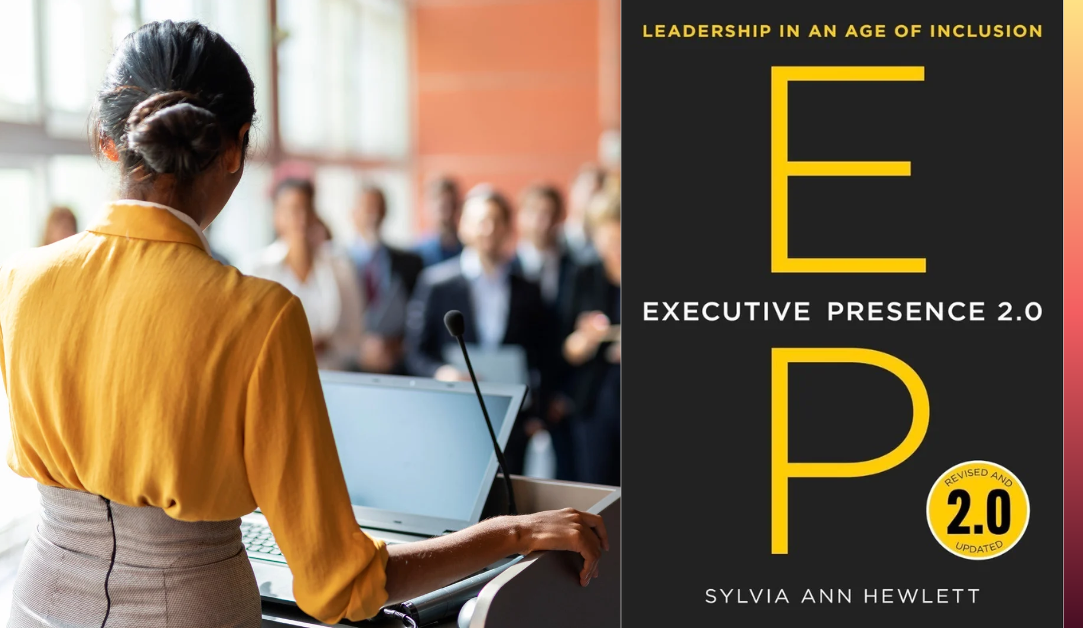
Executive Presence 2.0: Leadership in an Age of Inclusion by Sylvia Ann Hewlett is the reference framework on the topic. Published in 2023, it breaks executive presence into three parts: gravitas, communication, and appearance.
The updated edition was written after the COVID-19 pandemic. It addresses hybrid leadership, how to command attention when the room is a video call, and the role of psychological safety as leadership becomes more inclusive.
- Best for: readers who want the research-backed vocabulary that HR and leadership teams already use when they discuss who is ready to move up.
- Keep in mind: the framework describes how decision makers read you. What your own background adds to that picture is left for you to supply.
- Audiobook: available, about nine hours, narrated by Rosalind Ashford.
How Executive Presence 2.0 compares to my book
Hewlett offers a research-based framework built on gravitas, communication and appearance. My book starts from the inside, with four pillars: your values, your character and personality traits, your cultural attributes and your leadership interaction skills.
The two books work well together. Hewlett gives you the language a promotion committee speaks, and inside-out work shows you what you have to say in it. I wrote a full side-by-side of Executive Presence 2.0 and my book for your reference.
2. Executive Presence by Joel A. Garfinkle (2022)
[Executive Presence: Step Into Your Power, Convey Confidence, & Lead With Conviction (https://link.amazon/B0hqr41tG) by Joel A. Garfinkle turns coaching experience into blueprints. He draws on data from thousands of executive coaching clients and workshop participants.
The core of the book is his 3×3 model: nine competencies grouped under three domains, which he calls gravitas, authority, and expression. Its distinctive strength is a structured, step-by-step route past imposter syndrome toward authority that still feels like your own.
- Best for: readers who want a clear sequence to follow, one competency at a time.
- Keep in mind: a model gives you the structure, and deciding how each competency sounds in your own voice is still your work. That matters for professionals who already code-switch all day.
How Garfinkle’s Executive Presence compares to my book
Garfinkle wins on structure. His imposter syndrome material is laid out as a step-by-step sequence, and readers who freeze without a plan will find one here.
The difference is where you begin. Inside-out work starts with the recognition and perception of yourself, your family story, or a cultural tradition of deference, and asks how each one already builds your authority.
3. Executive Presence for the Modern Leader by Debra Benton (2021)
Executive Presence for the Modern Leader: A Guide to Cultivating Success and Thriving in the Workplace by D.A. (Debra) Benton is the most hands-on of the three. Published in 2021, it focuses on emotional intelligence, communication styles, and self-assessments.
Its strength is practical. Writing prompts and business etiquette guidance are designed to make you more memorable and more credible, so you finish with notes about yourself as well as notes about the book.
- Best for: readers who learn by reflecting on paper and enjoy a workbook feel.
- Keep in mind: etiquette norms vary across cultures and industries. If you grew up with different norms, read any etiquette advice as one dialect among several.
How Executive Presence for the Modern Leader compares to my book
Benton wins on hands-on reflection and everyday polish. Her prompts get you writing about yourself, which many leadership books only recommend in passing.
My book complements hers with a different question: which of your own cultural attributes already read as presence in the right setting? Warmth, formality and collective credit-giving can all signal leadership once you name them on purpose.
Think of a multicultural finance manager whose updates always say “we,” because that is how leadership sounded in his tradition. Her director may hear that as hiding her role. Seen inside-out, giving the team credit is part of her leadership brand, and one added sentence about the decision she made lets both truths stand.
Which of these executive presence books fits you?
The right book depends on what you need most at this stage of your career. Match your situation to the list below.
- Choose [Hewlett’s Executive Presence 2.0] if you need the shared language of senior leadership and want to understand how decision-makers judge readiness.
- Choose [Garfinkle’s Executive Presence] if self-doubt keeps you quiet and you want a guided path through it.
- Choose [Benton’s Executive Presence for the Modern Leader] if you want prompts to write through and practical polish for daily interactions.
If inclusion is your main concern, Hewlett’s is the only one of the three whose subtitle names it: Leadership in an Age of Inclusion.
What books on developing executive presence leave out
All three books are generous and useful. Yet, as I read them, none starts from cultural identity as a source of presence. Each helps you meet a standard, and none begins by asking what your background adds to it.
That starting point matters. For immigrant and multicultural leaders, it decides whether growth feels like becoming more yourself or less. DEI and L&D leads choosing reading for an ERG face the same choice, and pairing one of these books with a title that treats identity as an asset gives members both halves.
For that missing layer, my explainer on executive presence looks at what the standard definition tends to overlook and where your background fits in.
Check out our free executive presence worksheet to help you find the presence your own background already gives you.
FAQ
What was the Ugly Betty show about?
“Ugly Betty is an American comedy-drama television series developed by Silvio Horta, which aired on ABC from September 28, 2006, to April 14, 2010. It is based on the Colombian telenovela Yo soy Betty, la fea, created by Fernando Gaitán. The series follows Betty Suarez, a smart and well-meaning young woman from Queens, New York, who lacks fashion sense but secures a job at a high-end fashion magazine, Mode. As she navigates a glamorous but cutthroat industry, Betty challenges stereotypes and expectations while advancing her career and maintaining close ties to her family.” [Quote from (https://en.wikipedia.org/wiki/Ugly_Betty)]
When was Ugly Betty The Reunion aired?
The reunion interview aired on ABC’s Good Morning America on Friday, October 23, 2026. The cast reunited for an interview with ABC News’ Chris Connelly, and ABC also posted a five-minute video of the interview with the article.
Are these executive presence books available as audiobooks?
Executive Presence 2.0 is available as an audiobook. For Garfinkle’s and Benton’s books, check your audiobook platform and search by the full subtitle, because several books share the title Executive Presence.
Should I read the 2014 Executive Presence or the 2.0 edition?
Read [Executive Presence 2.0], published in 2023. It replaces the 2014 edition and reflects hybrid work and a more inclusive workplace.
Can you build executive presence from a book alone?
A book gives you language, a framework and room to reflect. Presence grows when you bring that understanding into real rooms, which is why I suggest pairing an outside-in book with inside-out work on your own background.
When you are ready to build presence from who you already are, visit my site to explore Speak Up!.
Edited with AI