This article contains affiliate links. If you buy something through them, we may earn a small commission at no extra cost to you.
Written by the Speak Up! Team
Sylvia Ann Hewlett’s updated research is the best map of the standard you are judged against. Here is what it changed, where it leaves multicultural professionals, and why presence built from the inside out holds up better than presence built to match a template.
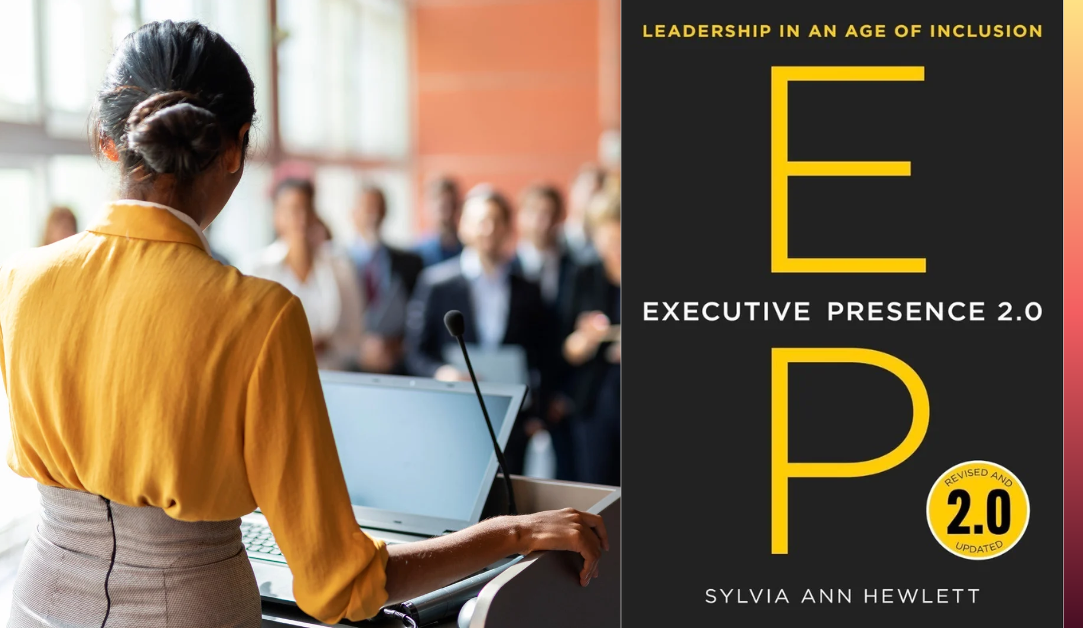
Sylvia Ann Hewlett’s Executive Presence 2.0: Leadership in an Age of Inclusion is the most-cited book in this field, and deservedly so. It is a decade of survey research into how senior leaders decide who is ready for more. If you want the definition of executive presence, the three pillars, and what the standard advice overlooks, I covered that separately in Why the Definition of Executive Presence has a Blind Spot.
This article does something narrower. It sets Hewlett’s book beside my own, Speak Up! Tell Your Story to Influence Others, because the two disagree on something that matters a great deal if your name, accent, or background doesn’t match the template. We agree on most of the diagnosis. We part company on the direction the work should run.
What changed in Executive Presence 2.0
Hewlett published the original in 2014. For the 2023 update, she returned to the field with the same questionnaire, surveying in 2022 and early 2023, and added seasoned leaders and thirty-something executives from fintech, gaming, and media.
Her headline finding is continuity. A pandemic, #MeToo, Black Lives Matter, and a war in Europe did not dislodge the three pillars. What moved is the content inside them. Before 2008, a charismatic personality marked someone out as leadership material; after the Great Recession and Covid, steadiness under pressure counts for more than wattage. Leaders now say they want confidence paired with authenticity and inclusiveness, the ability to run a remote team, and ease on video and social media.
Eye contact turned out to matter enormously, which in practice means rehearsing until you no longer need your notes. The second half of the book turns to women, people of color, and other nontraditional leaders, including how to give and receive honest feedback across lines of race and gender.
Read that list as an immigrant professional and two things stand out. Authenticity has been written into the code, which is genuine progress. And the people who decide what reads as authentic are, for the most part, the same people as before.
The template nobody names
Long before anyone used the phrase with you, you had absorbed a picture of what a leader sounds like. The formula is familiar enough to recite: gravitas, polished communication, the right appearance. Take the room. Sound certain. Look like you belong.
It is a real standard and it has carried real careers; Hewlett’s data makes that plain. But look at what every item on the list is measuring. Not the quality of your thinking. The impression your thinking makes on one particular kind of observer.
Then look at where the picture came from. It is not a neutral composite assembled from effective leaders around the world. It is one culture’s set of defaults, written down and quietly promoted to a universal.
So, you do what capable people do with a standard they cannot meet by default. You adapt around it. The accent gets managed. The hair is hidden or straightened. The colors and accessories get disciplined. The story about the country you built a career in is left out, because it takes too long to explain and you are not certain it helps you. The instinct your background handed you, the one that would have caught the problem three slides earlier, stays unsaid because it arrives in the wrong format for the room.
Every one of those is a sensible decision in the moment. Together they produce something nobody intended: a person the room can process quickly and cannot describe afterwards. Easier to read, harder to remember. For a reputation, that is not a draw. That is the loss.
Outside in, or inside out
This is the fault line between the two books, and it is sharper than any disagreement about tactics.
Hewlett’s method runs from the outside in. Here is the standard, here is how it is scored, here is how far you currently sit from it, here is how to close the distance. The work is calibration, and for someone whose starting position is already close to the template, calibration is cheap and it works.
Speak Up! runs the other way. It starts with what is actually there, the career you built elsewhere, the markets you understand from the inside, the ambiguity you have already survived, the way your particular history taught you to read a situation. Then builds the public version of you out of that material. The aim is not to seem more like the template. It is to be specific enough that the template stops being the measure. Nobody has to maintain that version under pressure, because there is nothing in it to maintain.
Who each book is written for
Hewlett’s evidence is drawn from what senior executives look for when they decide who rises, and her illustrations run to figures like Steve Jobs, Michelle Obama, Volodymyr Zelenskyy, Amanda Gorman, and Gustavo Dudamel. The book reads like a briefing delivered from inside the boardroom. It is valuable to anyone who wants to understand the rules, and most directly useful to people already near the top, founders scaling a company, and the leaders and HR teams who coach them.
Speak Up! is written for the part of the pipeline underneath that: mid-level managers and rising corporate leaders, especially multicultural and immigrant professionals, who are being measured against the code without having been granted the benefit of the doubt yet. I wrote it from that position, as an Argentine immigrant rebuilding a career in the United States.
When you are allowed to be yourself
Hewlett is candid about the tension between conformity and authenticity. Every professional she interviewed wrestles with it, and women and people of color, she writes, are effectively asked to pass as the dominant leadership model. Her reassurance is that the pressure eases with time: those who establish real gravitas earn the right to bring more of themselves to work.
At the top, that is accurate. It is also the clearest difference between our two books, because for a mid-level manager the sequence is circular. The conformity that is supposed to purchase your seniority is the same conformity that makes you forgettable, and forgettable people do not get promoted into the gravitas that would finally let them stop conforming. Meanwhile, the background you have agreed to mute is the most distinctive evidence you own.
Speak Up! treats authenticity as a starting condition rather than a reward collected later. Your story, your heritage, your family values, and the route that brought you here are what gravitas gets built out of now.
The two books side by side
| Executive Presence 2.0 | Speak Up! | |
|---|---|---|
| Primary reader | Senior leaders, executives in waiting, founders scaling up, and those who coach them | Mid-level managers and rising corporate leaders, especially multicultural and immigrant professionals |
| Evidence base | Surveys and interviews with senior executives, 2012 and 2022 | Storytelling practice, the author’s own immigrant career, and workshops with multicultural professionals |
| Direction of the work | Outside in: learn the standard, close the distance | Inside out: start from your material, make it legible |
| Core question | What do senior leaders look for? | What is already yours, and how do you tell it? |
| View of authenticity | Earned over time, once gravitas is established | The raw material gravitas is made from |
| What you leave with | A map of the code and its pitfalls | Your personal brand story and a framework to tell it |
| Languages | English | English, and Spanish as ¡HABLA YA! |
Which one should you read first?
If you sit in or near the C-suite, or you coach people trying to get there, start with Hewlett. Her account of the standard is unmatched and you will be applying it to other people’s careers as much as your own.
If you are mid-career and carrying feedback about presence that nobody will define, start with Speak Up! and read Hewlett second. The order is not a preference. Learn the code first and you will spend the next year closing a gap to someone else’s shape. Settle what you are for first, and the code becomes information about your environment rather than a description of who you should become.
For a wider reading list, including Goyder on voice, Gallo on presentations, and Cuddy on self-doubt, see The Best Executive Presence Books and Audiobooks.
FAQ
How is Executive Presence 2.0 different from the original?
The original, Executive Presence: The Missing Link Between Merit and Success, appeared in 2014. For the 2023 edition, Hewlett reran the same survey in 2022 and early 2023. The three pillars held, but leaders now weight calm under pressure, authenticity, inclusive leadership, remote team leadership, and command of video and social media more heavily than they did a decade earlier.
Does Executive Presence 2.0 address multicultural professionals?
Yes, and more directly than most books in the category. Hewlett names the double standards women and professionals of color face, and the second half of the book deals with nontraditional leaders, including guidance on honest feedback across lines of race and gender. What it does not do is question whether the standard itself should be the destination.
Who is Speak Up! written for?
Mid-level managers and rising corporate leaders, especially multicultural and immigrant professionals who want to build presence out of their own story instead of imitating a template. It is rated 4.5 out of 5 on Amazon, and you can read what other professionals said about it.
If you are tired of presence advice written for someone whose name nobody mispronounces, start from your own story. Find out more about my work and my book at susanagbaumann.com, or read a little about where I come from and why I wrote this book.
Edited with AI